
AI Chatbots
Which questions can an assistant answer usefully?
Answer routine questions from information you control.
Discuss your project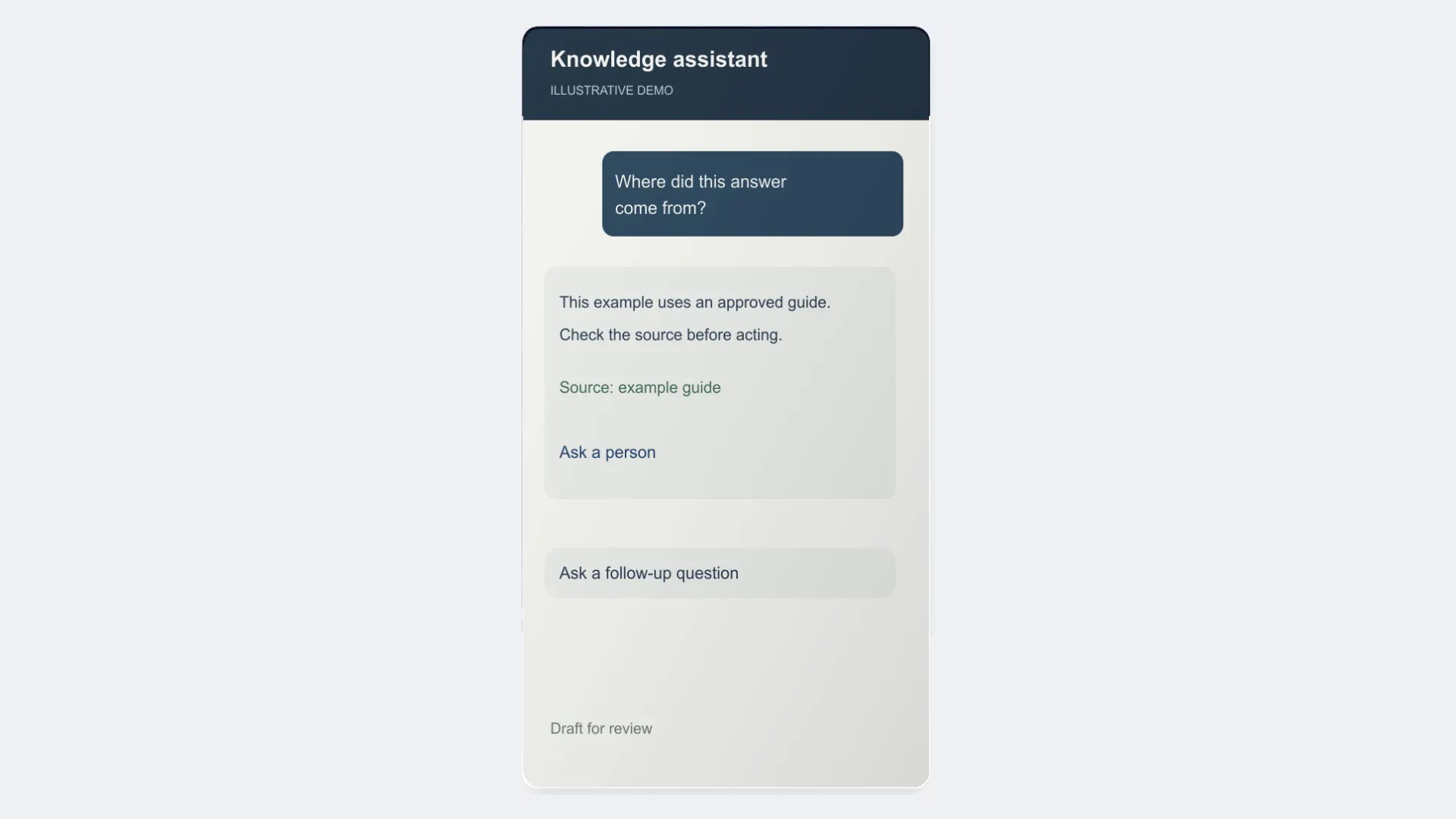
What it is
I build assistants for a defined set of customer or internal questions. I establish what they can answer from your approved information and what they should pass to a person.
- You receive repeated questions with answers in sources you can approve and maintain.
- A person can take over when information is missing, uncertain or outside the assistant's scope.
Included work
- A question and knowledge map, with gaps in the source material identified
- A working assistant connected to agreed content and systems
- An evaluation of answer accuracy, unanswered questions and escalation
- Editing guidance and an owner for keeping sources up to date
Illustrative possibilities
What this can look like at work
Examples of possible applications, not customer cases or measured results. We check sources, permissions and human review for your situation.
Questions outside opening hours
Customer service teams offering a defined first answer across time zones.
- The assistant answers from approved service, process and price information in the agreed languages.
- Visitors can see they are talking to AI. Unknown or consequential questions go to the named contact route.
- An assistant being available does not mean a person is always available; handover expectations are stated clearly.
From question to appointment
Customer service and sales teams handing an enquiry to the right person.
- The assistant asks the agreed intake questions and offers WhatsApp or a form with the visitor's approval.
- The question and permitted context travel to a responsible person; booking requires a supported, authorised connection.
- We test incomplete requests, language changes and failed handovers before release.
Fielding frequently asked questions
Support departments maintaining a shared set of approved answers.
- The assistant uses an owned question-and-answer set with approved language versions.
- It says when the sources do not answer a question and offers a route to a person rather than inventing a reply.
- The content owner reviews unresolved questions and approves changes to the sources.
Rates and terms
Commercial and support teams explaining published rates and conditions.
- The widget answers from the current approved rate and terms text, with the relevant source available.
- Negotiated prices, ambiguous conditions and binding commitments go to the commercial owner.
- We test outdated source versions and translations; publishing a new rate requires an agreed update process.
Which service fits
Organisations helping visitors navigate services across departments or countries.
- A small set of agreed questions points to approved service information or the enquiry form.
- The assistant can explain the options in supported languages without making a professional suitability decision.
- The receiving team gets the permitted context; unclear requests stay open for a person to assess.
How we work
Stage 01
Map questions and approved answers
We define the users, source owners, allowed topics and supported languages. I check the website or internal environment before confirming how the assistant can be added.
Stage 02
Build answers and handover
I connect the approved content and set limits on access and actions. The assistant identifies itself, flags missing answers and offers an agreed route to a person.
Stage 03
Evaluate questions and exceptions
We test representative questions, conflicting sources, permissions and language versions. The owner checks answers and handovers before release.
Stage 04
Assign source maintenance
I provide editing instructions and document provider settings, data handling and updates. A named person owns unanswered questions and any continuing knowledge updates.
Delivery and ownership
We review the agreed work against the acceptance criteria with its responsible owner. I record what is ready, what remains open and who will maintain it. Approval to use or publish the result is a separate decision.
- Documentation, accounts, source material and ownership are agreed before work begins.
- Your IT team can review access, integrations, security requirements and operating arrangements.
- Guidance covers the intended users and languages, review responsibilities and exception handling.
What we agree first
What I need from you
Approved answers and source material, someone responsible for updates, and a contact who can handle questions the assistant cannot resolve.
The assistant's scope and access are agreed before launch. It can make mistakes, so decisions with serious consequences stay with a person.
I work directly with you from the Netherlands. Remote collaboration is available across Europe, Asia and the Americas. Travel, working languages and time zones are agreed per engagement.
Before we begin
Can an assistant work on our existing website?
Often, through a widget or integration. I check the website, content access and technical restrictions before confirming compatibility. An internal assistant can instead sit in a dedicated application.
How are mistakes and customer data handled?
We agree what the assistant may access, store and share, along with provider settings and escalation rules. I test representative questions and missing information. Important decisions stay with a person, and sources need an owner.